









Implementation of LabVIEW®-based joint-linear motion blending on a lab-manufactured 6-axis articulated robot (RS2)

Implementation of LabVIEW®-based joint-linear motion blending on a lab-manufactured 6-axis articulated robot (RS2)

Dong Sun Lee, Won Jee Chung, Chang Doo Jung, Jun Ho Jang, International Conference on Mechatronics and Automation (ICMA), August 2012, pp. 2423-2428.

  • Abstract

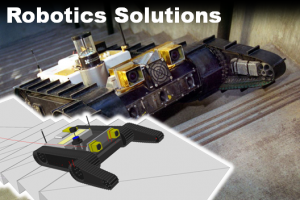
    For fast and accurate motion of 6-axis articulated robot, more noble motion control strategy is needed. In general, the movement strategy of industrial robots can be divided into two kinds, PTP (Point to Point) and CP (Continuous Path). In recent, industrial robots which should be co-worked with machine tools are increasingly needed for performing various jobs, as well as simple handling or welding. Therefore, in order to cope with high-speed handling of the cooperation of industrial robots with machine tools or other devices, CP should be implemented so as to reduce vibration and noise, as well as decreasing operation time. This paper will realize CP motion (especially joint-linear) blending in 3-dimensional space for a 6-axis articulated (lab-manufactured) robot (called as “RS2”) by using LabVIEW® [6] programming, based on a parametric interpolation. Another small contribution of this paper is the proposal of motion blending simulation technique based on Recurdyn® V7, in order to figure out whether the joint-linear blending motion can generate the stable motion of robot in the sense of velocity magnitude at the end-effector of robot or not. In order to evaluate the performance of joint-linear motion blending, simple PTP (i.e., linear-linear) is also physically implemented on RS2. The implementation results of joint-linear motion blending and PTP are compared in terms of vibration magnitude and travel time by using the vibration testing equipment of Medallion of Zonic®. It can be confirmed verified that the vibration peak of joint-linear motion blending has been reduced to 1/10, compared to that of PTP.

    How Multibody Dynamics Simulation Technology is Used

    RecurDyn was used to determine whether changing the velocity profile of a 6-axis articulated robot would result in stable motion of the end-effector. Efficiency of the robot is improved by implementing a control strategy that limits vibration and noise.

    Get This Paper

    Related Case Studies

Dynamics and control of a spatial rigid-flexible multibody system with multiple cylindrical clearance joints

Dynamics and control of a spatial rigid-flexible multibody system with multiple cylindrical clearance joints

Cheng Liu, Qiang Tian, Haiyan Hu, Mechanism and Machine Theory, June 2012, Volume 52, pp 106-129.

  • Abstract

    The dynamics and control of a rigid-flexible multibody system with multiple cylindrical clearance joints are studied via the Absolute Coordinate Based (ACB) method that combines the Natural Coordinate Formulation (NCF) describing rigid bodies and the Absolute Nodal Coordinate Formulation (ANCF) describing flexible bodies. The spatial cylindrical joints with clearances are modeled by two rigid bodies, that is, the journal and bearing, where the difference in radius and axial directions defines the radial clearance and axial clearance, respectively. A new four-point contact kinematic model of NCF is proposed for the rigid cylindrical clearance joint. A combined control scheme consisting of a feedforward torque and a PID feedback controller is adopted to track the joint trajectories. Based on the principle of virtual work, a new and simple method is proposed to evaluate the feedforward torque. To improve computational efficiency, an OpenMP based parallel computational strategy is used to solve the large scale equations of motion. Three examples are given to verify the effectiveness of the proposed formulations and demonstrate the complex dynamics of rigid-flexible multibody systems with multiple cylindrical clearance joints.

    How Multibody Dynamics Simulation Technology is Used

    RecurDyn has the capability of simulating the multibody dynamics of rigid and flexible bodies using the FFlex module. In this paper, RecurDyn is used to analyze a rigid-multibody system with multiple cylindrical clearance joints. RecurDyn simulations agree well with a simplified model proposed by the author and provide validity to both methods used to analyze cylindrical clearance joints.

    Get This Paper

    Related Case Studies

A method to predict the derailment of rolling stock due to collision using a theoretical wheelset derailment model

A method to predict the derailment of rolling stock due to collision using a theoretical wheelset derailment model

J.S. Koo, H.J. Cho, Multibody System Dynamics, April 2012, Volume 27, Issue 4, pp 403-422.

Numerical modeling of journal bearing considering both elastohydrodynamic lubrication and multi-flexible-body dynamic

Numerical modeling of journal bearing considering both elastohydrodynamic lubrication and multi-flexible-body dynamic

J. Choi, S.S. Kim, S.S. Rhim, J.H. Choi, International Journal of Automotive Technology, February 2012, Volume 13, Issue 2, pp 255-261.

Abstract

This study uses an elastohydrodynamic lubrication model coupled with multi-flexible-body dynamics (MFBD) to analyze dynamic bearing lubrication characteristics, such as pressure distribution and oil film thickness. To solve the coupled fluid-structure interaction system, this study uses an MFBD solver and an elastohydrodynamics module. The elastohydrodynamics module passes its force and torque data to the MFBD solver, which can solve general dynamic systems that include rigid and flexible bodies, joints, forces, and contact elements. The MFBD solver analyzes the positions, velocities, and accelerations of the multi-flexible-body system while incorporating the pressure distribution results of the elastohydrodynamics module. The MFBD solver then passes the position and velocity information back to the elastohydrodynamics solver, which reanalyzes the force, torque, and pressure distribution. This iteration is continued throughout the analysis time period. Other functions, such as mesh grid control and oil hole and groove effects, are also implemented. Numerical examples for bearing lubrication systems are demonstrated.

How Multibody Dynamics Simulation Technology is Used

RecurDyn is coupled with an elastohydrodynamic module to analyze dynamic bearing lubrication characteristics, such as pressure distribution and oil film thickness. The elastohydrodynamic module transmits pressure, force, and torque data into RecurDyn. The FFlex module in RecurDyn allows for compliance effects to be analyzed while solving the dynamics of the system. These results agreed with experimental results and can now be used to improve the design.

Get This Paper

Related Case Studies

Simulated Analysis of a Wheeled Tractor on Soft Soil Based on RecurDyn

Simulated Analysis of a Wheeled Tractor on Soft Soil Based on RecurDyn

Wenqian Huang, Feijun Xu, Jishuai Ge, Chi Zhang, Computer and Computing Technologies in Agriculture V, 2012, pp 332-342.

  • Abstract

    A simulation model of a wheeled tractor was built using the multi-body dynamics software RecurDyn. The model consisted of four wheels, front and rear axles, and a body frame. An interaction model between tires and soft soil was established using the Soil-tire module of RecurDyn. The simulations of displacement and force of the tires were conducted on 20° up-slope, 44° ultimate up-slope, 20° down-slope and 34° ultimate down-slope roads respectively. The performance of a wheeled tractor over a cylindrical obstacle was analyzed under two different speeds. Results showed that forces of the front wheel were different on different slope roads. The maximum impact force of the front wheel increased by 68% as the up-slope increasing from 20° to 44°. The maximum impact force of the front wheel decreased by 8% when the down-slope changing from 20° to 34°. The maximum force of the front wheel decreased by 16% when the wheeled tractor over a cylindrical obstacle with the speeds decreasing from 1.356m/s to 0.678m/s.

    How Multibody Dynamics Simulation Technology is Used

    The Soil-Tire module of RecurDyn can be used to model a wheeled tractor running over various terrains. Displacements and impact forces of the tires could be compared across the different terrains. The result was that the trends of the loading cases as a function of terrain slope and vehicle speed could be understood and quantified.

    Get This Paper